

“I See You”: One Mother’s Journey Through Caregiving After Brain Injury

Each November, we recognize National Caregivers Month—a time to honor the millions of people who provide physical, emotional, and daily support to loved ones recovering from injury or illness. In that spirit, we invited caregiver and mother Maryam Mohit to share her story.
Three years ago this month, everything changed for Maryam Mohit.
Her 16-year-old son, Ari, had gone out to pick up some takeout food on his bike—something that, as a hungry teenager, he did often. A short while later, Maryam got the call that every parent dreads: a voice on the end of the line asking, “Are you the mother of…?”
Ari had been struck by a car while crossing an intersection. He was mere blocks from home.
“I had no idea of the journey to come,” Maryam says.
The longest night
That first night in the emergency room, Maryam was told her son had suffered a severe traumatic brain injury. She remembers signing consent forms for the emergency surgery that the doctors would need to perform to relieve the pressure on his swelling brain. “I felt like I was moving through a viscous fog, just doing whatever the doctors told me to do,” she remembers.
Because it was during the COVID pandemic, visiting hours in the ICU were restricted, but Maryam was allowed to stay by Ari’s side, sleeping in a fold-out armchair. Every morning, she watched the neurosurgical teams run their rounds, calling out brisk commands to Ari—“Wiggle your toes!” “Give me a thumbs up!”—in the hopes that he might respond. He didn’t.
Prior to the accident, Ari had been living his best life. He had gained a lot of confidence backpacking in Colorado over the summer, he was just starting his junior year and was excited about applying to college, and he had a wonderful group of friends. “Seeing Ari inert, unresponsive, and as pale as the hospital sheets covering his body was terrifying,” Maryam says. “During those first few weeks, we didn’t know if he was going to live or die.”
During one particularly difficult night, when Ari was battling pneumonia in addition to his brain injury, she escaped to the hospital’s rooftop healing garden. “I looked up at the millions of stars,” she remembers. “Each one felt like a mother who had lost a child to some tragedy. I felt a piercing sense of connection with them all, and I just sobbed and sobbed.”
Learning a new language
It wasn’t until months later that Maryam began to grasp the true scope of Ari’s injury. “Even now, I don’t think I can truly understand what it feels like to be him,” she says.
Doctors had warned her not to Google the prognosis for “diffuse axonal injury”—Ari’s diagnosis—as it would look too grim. Still, she did what any mother would do: she researched everything else. “I read countless research articles on every challenge Ari faced,” Maryam says. “From spasticity (a disruption in muscle movement patterns that causes certain muscles to contract all at once in movement or at rest), to dysarthria (difficulty producing intelligible speech), to visual snow (a rare neurological condition that creates visual disturbances, akin to watching static on a television). I used to joke that learning new things is good for you as you age, but these were not the things I wanted to learn.”
As Ari slowly began to recover his speech, Maryam searched for ways to help him describe what his brain felt like without leading his answers. “‘Does it have a color?’ I’d ask. He’d say, ‘Purple.’ ‘A texture?’—‘Soft, melty, pillow-like.’ ‘A shape?’—‘A circle with no edges or corners. There are no doors, no way out.’”
“It was fascinating,” she says, “but also so emotionally painful.”
The hard work of recovery
Ari spent nearly 10 months in hospitals and rehabilitation programs, during which he had to relearn how to stand, walk, talk, and use his hands, before returning home, where his recovery journey continued. Everyday tasks were no longer second nature. “Every little thing had to be broken down into its component parts,” Maryam says. “Relearning to brush his teeth, for example, took step after painstaking step.”
Recovery from brain injury is rarely just physical. Emotional dysregulation is common among TBI survivors, but in that respect, Ari has been fortunate. “We’ve been spared the angry outbursts that so many families face,” Maryam says. Instead, his challenges have centered on post-TBI seizures, balance issues, and being a fall risk, and the delicate process of tapering medications carefully to avoid withdrawal.
There are also the social and psychological hurdles—recognizing when Ari has “hit the wall” and needs to rest, which is often much sooner than someone without a brain injury; figuring out how to integrate into school when all his classmates have already graduated; and helping him summon the grit to keep showing up for the seemingly endless cycle of physical, occupational, and speech therapy sessions.
“It’s not the way a teen wants to spend his time,” Maryam admits, “but it’s crucial for his—hopefully—full return to independence.”
Redefining what matters
Before the accident, Maryam worked in tech in California’s Bay Area and was enjoying the early stage of an empty nest, with Ari being the only one at home (her two older children were in college on the East Coast). She and Ari shared nightly rituals of tea and conversation. “After dinner, we’d talk and laugh about our days,” she recalls.
After the accident, what began as a temporary leave of absence from work stretched into months, then a year. “Without a loving advocate,” she says, “there would be no one to manage Ari’s recovery process — and it was a 24/7 job, more intense than any I’d ever had.”
Her routines now mirror those she remembers from early motherhood: preparing meals, managing appointments, arranging therapies, and adapting constantly to Ari’s evolving needs. “I didn’t expect to be on the preschool-mom schedule again,” she laughs. “But here I am.”
Even with those shifts, Maryam says she’s found a deep sense of meaning in this new season of caregiving. “My world has gotten more focused,” she explains. “I have no doubt about my purpose. It’s to help my son have the fullest recovery possible.” And it’s that focus that has reshaped her relationships — not to mention her outlook on nearly everything. “Some friendships have faded, but others have deepened,” she says.
“After something like this, your sense of what matters shifts,” she continues. “Things that used to bother me don’t even register now. You start focusing on the essentials, on savoring the good moments and breathing through the bad ones.”
She draws strength from the Serenity Prayer and from Viktor Frankl’s Man’s Search for Meaning. “Frankl says that we ‘have a space between stimulus and response where we can choose our attitude,’” she reflects. “I couldn’t rewind time. All I could do was choose how to respond to the truth in front of me.” That choice is what keeps her grounded and grateful. “I appreciate the scent of jasmine on my patio, a beautiful sunrise, and a cute dog ambling by,” she says. “While I never would have chosen this path, I cherish each and every day, and a good absurdist sense of humor doesn’t hurt.”
The many facets of advocacy
Long before Ari came home from the hospital, Maryam realized caregiving also meant becoming his advocate.
“Advocacy looks like not being embarrassed by my medical ignorance,” she says. “It means asking questions until I understand what the doctors are telling me. I’m the continuity of care between all these providers over time, so I need to understand.”
Over the years, that role has expanded. “I started learning what systems and supports actually existed for brain injury survivors in my state—and what didn’t,” she says. “Because the truth is, brain injury survivors need advocacy that goes beyond their individual case. We need infrastructure, laws, and policies that make recovery possible.”
Day to day, her advocacy also means paying attention to Ari—what he feels, what he needs, and what he dreams about—and finding the people and therapies that can help. She keeps careful track of his symptoms, sleep, and medications; coordinates with doctors and teachers; and appeals insurance denials when necessary.
She’s also become, in her words, “a researcher and explorer.” She set up Google alerts for brain injury studies, reached out to medical experts around the world when new symptoms emerged, and found therapists who “pass the vibe check” — people Ari genuinely connected with.
“When you love someone with a brain injury, you become the quarterback of their recovery,” she says. “There’s no roadmap, no one person managing the big picture for you. You just keep scanning the horizon for what might help next.”
The power of being seen
Amid the exhaustion and determination, Maryam admits there have been moments of deep loneliness. “Friends would text me, telling me I was so strong and resilient,” she says. “Weirdly, that sometimes left me hollow. It felt like cheerleading instead of acknowledging how terrible this can be.”
She recalls a poem shared by another parent of a child with a brain injury that puts words to how she feels, called “I See You.” It begins: “I see you running your child to therapy when your friends are running their kids to sports. I see you cringing when people whine about petty things. I see you digging for depths of strength you never dreamed you had. What you’re doing matters. It’s worth it.”
Maryam says she cries every time she reads it, because “it captures what it feels like to be a caregiver — and to finally feel seen.”
Redefining self-care as a caregiver
In the ICU, when people told her to “take care of herself,” Maryam found it frustrating. “To me, taking care of my son was taking care of myself,” she says. “I didn’t need manicures or massages. What helped me was sleep, healthy food, and friends who would walk with me so I could breathe fresh air.”
Three years later, Maryam’s “self-care” looks different. It’s trusting skilled aides so Ari can attend college classes while she takes a workout or dance class. It’s knowing he’s in good hands so she can plan a short trip to visit her daughter at university. “It’s not bubble baths and spa days,” she says. “It’s creating systems of support that make space for both of us to keep growing.”
Moments of hope—and words for other caregivers
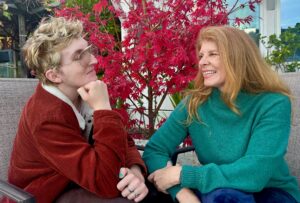 Six months after the accident, Ari spoke his first word. “It came out slowly — ‘mmm…maaa…maaa…’— and then it became ‘Mama.’ It was glorious,” Maryam remembers. “I thought, he can speak!”
Since then, every milestone feels like summiting a new peak. “Every time we solve a mystery or find a new therapy, it gives me hope,” she says. “It motivates me to keep going.”
When asked what she’d tell someone just beginning their own caregiving journey, Maryam doesn’t hesitate. “Learn as much as you can,” she says. “There’s no roadmap, because every brain injury is different. Know that there’s a lot on your shoulders, but you’re not alone. Find other caregivers, because you’ll need each other.”
She also adds this: “Remember that as much as this has changed your life, it’s changed your loved one’s life more. You’re both doing the best you can. That’s all any of us can do.”